The Essential Companion for Your Home Freeze Dryer: Mastering the Log Book
Stepping into the world of home freeze drying opens up incredible possibilities—from preserving seasonal produce to creating long-lasting meals and unique snacks. While the machine itself is the star of the show, the success and efficiency of your entire operation often hinge on a surprisingly humble tool: a well-maintained Home Freeze Drying Log Book. It’s the unsung hero that transforms a chaotic, experimental process into a reliable, repeatable system. Yet, many enthusiasts dive in without recognizing its critical role, leading to wasted batches, lost data, and missed opportunities for improvement.
The Common Pitfall: Treating Freeze Drying as an Informal Experiment
A common mindset among beginners is to treat freeze drying like casual cooking—a bit of this, a bit of that, relying on memory for settings and outcomes. You might think, "I’ll remember that strawberries took 20 hours," or "I know which rack I used for the herbs." In practice, without a dedicated log, these details fade. This informal approach leads to several tangible problems. First, inconsistent results become the norm. Without recorded data on pre-freeze times, load weights, or chamber temperatures, replicating a perfectly dried batch is guesswork. Second, troubleshooting becomes nearly impossible. If a batch fails—resulting in spoilage or incomplete drying—you have no historical data to analyze. Was the ambient humidity higher? Did you overload the tray? Without the log, you’re left repeating the same mistakes.
A better approach is to view your freeze dryer as a precision instrument, much like a laboratory device. The log book is its control panel. By committing to record each run from the start, you build a personalized database of knowledge. This isn’t about bureaucracy; it’s about empowerment. You’ll quickly learn your machine’s quirks, how different foods behave, and how to adjust for seasonal changes in your kitchen environment.
Overlooked Details in Choosing and Using a Log Book
Even when someone decides to use a log, they often overlook the design and functionality of the book itself. Using a generic notebook or random scraps of paper seems economical, but it creates fragmentation. Critical data gets scattered across pages, mixed with unrelated notes, and lacks a consistent structure for comparison. This makes it frustrating to find information weeks later when planning your next batch of apples or beef.
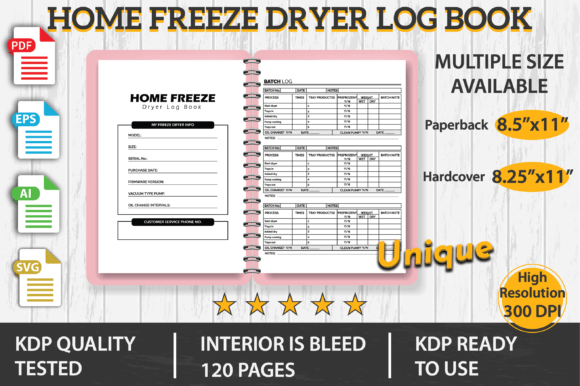
The features of a purpose-built Home Freeze Drying Log Book directly address these gaps. Consider the importance of having designated fields for each run: date, food type, initial weight, final weight, processing time, cycle settings, and notes on outcome. A professional design with bleed for clean printing ensures every page is fully usable, and a high-quality print-ready PDF means you can produce a physical book that feels like a proper tool, not a temporary makeshift. Having an editable source file (like AI or EPS) is a feature often underestimated. It allows you to adapt the log to your specific machine model or add custom fields for things like "batch for camping meals" or "experimental candy project," making it a living document that evolves with your skills.
The Critical Mistake: Neglecting Pre-Process Documentation
Most log entries focus solely on the machine’s run time and outcome. However, the pre-process phase is where many failures originate and is frequently undocumented. This includes preparation steps: how thinly you sliced the fruit, whether you pre-froze items on trays, the blanching time for vegetables, or even the room temperature when loading the machine. Skipping these notes means you might achieve a perfect dry on peaches one day and a poor result the next, with no clue that the difference was in the slice thickness.
Your log should have a section for "Preparation Notes." Here, you can jot down, "Mango slices: 1/4 inch, flash-frozen for 2 hours," or "Ground beef: formed into 1/2 inch pellets." This level of detail turns your log from a simple timer into a comprehensive recipe book for preservation. It allows you to refine your preparation techniques, saving time and improving quality over dozens of batches.
What to Check Before You Commit to a Log System
Before downloading or printing any log book template, take a moment to audit your own needs. Ask yourself: Do I process multiple food types regularly? Do I share the freeze dryer with family members who need clear instructions? Am I interested in calculating cost savings or yield percentages? A good log book should accommodate these goals. Look for a design that includes space for cost inputs (price of raw food) and yield outputs (weight after drying), enabling you to track economic benefits. Also, verify that the file provided is truly KDP-tested with no errors if you plan to use print-on-demand services; this ensures a smooth, professional production process without margin or formatting issues.
The physical dimensions matter too. An 8.5 x 11 inch (21.59 x 27.94 cm) format is standard and practical, offering ample space for writing without feeling cramped. A book with 120 pages provides substantial capacity for a year or more of regular use, preventing the need for multiple disjointed volumes. Choosing a log with these thoughtful features from the start prevents the mid-project scramble to upgrade your system, keeping your data unified and accessible.
The Advantage of a Structured Approach for Hobbyists and Entrepreneurs
For those venturing beyond personal use into small business—selling freeze-dried fruits, herbs, or complete meals—the log book becomes a cornerstone of quality control and customer trust. Imagine being able to assure a customer that Batch #47 of your strawberry chips was processed at a specific temperature for a recorded duration, with a known moisture residual. That traceability is invaluable. A common oversight for entrepreneurs is failing to integrate batch numbers or lot codes into their logging system. A dedicated Home Freeze Drying Log Book can be customized to include this, transforming your operation from a hobby kitchen to a documented production facility.
Furthermore, the log aids in communication and delegation. If a family member or assistant helps with the process, a clear, pre-formatted log entry sheet guides them on what data to collect, ensuring consistency no matter who operates the machine. This eliminates the "how did you do it last time?" conversations and streamlines teamwork.
In essence, investing in a well-designed log book is not about adding paperwork to your passion. It’s about removing guesswork, frustration, and waste. It turns the exciting capability of home freeze drying into a reliable, scalable, and deeply satisfying practice. By documenting the journey, you not only preserve food—you preserve knowledge, ensuring every batch is a step forward, not a repetition of past unknowns.